Tarot · 12 min read
Are Tarot Readers Using AI? What It Means for the Future of Tarot
Tarot has always been a language of symbols, intuition, and reflection. Now, some readers are exploring a new kind of mirror: artificial intelligence.
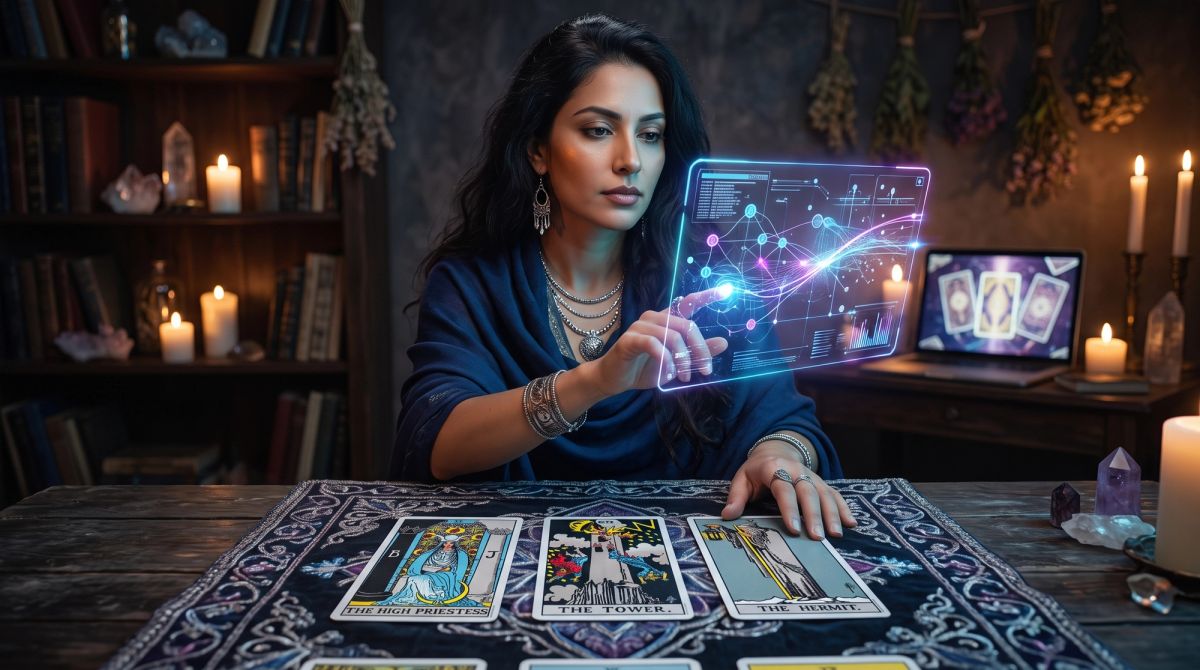
For centuries, tarot has offered people a way to sit with uncertainty.
A card is turned over. A familiar image appears. Something inside you reacts before the mind has had time to explain why.
Perhaps it is the High Priestess, quietly inviting you to trust what you already know.
Perhaps it is the Tower, asking you to stop holding together something that has already begun to fall away.
Or perhaps it is a card you did not want to see at all.
This is the heart of tarot.
The cards do not simply tell a story about the future. They create a space in which you can encounter yourself.
Today, another kind of tool has entered that space: artificial intelligence.
AI tarot readings are becoming increasingly accessible, allowing anyone to explore card meanings, ask questions, generate spreads, and reflect on symbolic patterns within seconds.
That raises an important question:
Can technology participate in something as deeply personal and spiritual as tarot?
The answer is more nuanced than either side of the debate suggests.
AI does not have to replace intuition.
And using AI does not mean abandoning spirituality.
Instead, we may be entering a new chapter in the long history of divination—one where technology becomes another mirror through which we explore the ancient language of the cards.
Tarot Has Always Been About More Than the Cards
It is easy to think of tarot as a collection of 78 meanings.
The Fool means beginnings.
The Lovers mean relationships or choices.
The Death card means transformation.
The Ten of Swords means endings.
But experienced tarot readers know that a meaningful reading is never simply a list of definitions.
The same card can speak differently depending on the question, the surrounding cards, the moment in someone's life, and the feeling that arises when the image appears.
The Queen of Cups can represent emotional wisdom in one reading and emotional overwhelm in another.
The Eight of Cups can mean walking away from something—but sometimes it can mean having the courage to discover what lies beyond the familiar.
The meaning lives somewhere between the symbol and the person looking at it.
That is why tarot has survived for so long.
It is not merely a system for predicting events.
It is a language for listening inward.
So, Are Tarot Readers Using AI?
Some are.
And that does not necessarily mean they believe a machine is psychic.
For many practitioners, AI tarot is simply another way to explore symbolism and perspective.
A reader might use an AI tarot tool to:
- explore different interpretations of a difficult card
- find connections between several cards in a spread
- discover questions they had not considered
- study tarot symbolism
- create journaling prompts
- experiment with different spreads
- reflect on a reading after a session
- approach a familiar card from a completely different perspective
In this sense, AI can function less like a fortune teller and more like a digital companion for reflection.
That distinction matters.
The spiritual value of tarot does not necessarily come from having the perfect interpretation.
Sometimes it comes from being asked the question you were avoiding.
AI Tarot Is a Mirror, Not an Oracle
One of the most useful ways to understand AI tarot is to think of it as a mirror.
You bring the question.
You bring the emotional context.
You bring your memories, fears, hopes, intuition, and lived experience.
The cards provide symbols.
AI can help you explore those symbols through language and association.
But the meaning you discover is still something you must sit with yourself.
An AI may tell you that the Hermit represents solitude, introspection, wisdom, and withdrawal.
But only you can recognize why the Hermit appearing today feels less like loneliness and more like permission to stop answering everyone else's calls.
That moment of recognition is where tarot becomes personal.
And that part cannot simply be generated for you.
What AI Tarot Does Well
AI has a genuine strength in one area that can be valuable to tarot students and practitioners:
It can offer perspective.
A single tarot card contains layers of symbolism.
There are visual details, elemental associations, numbers, mythology, traditional meanings, reversed interpretations, relationships between cards, and countless schools of tarot practice.
AI can help you explore those layers quickly.
Imagine pulling three cards:
The Moon - The Eight of Pentacles - The Star
Instead of receiving three isolated definitions, you could ask:
What story might these three cards tell together?
You might discover a narrative about moving through uncertainty, continuing to practice your craft, and eventually finding renewed hope.
You may agree with that interpretation.
You may reject it completely.
Either response can be valuable.
The purpose is not to surrender your intuition to the machine.
It is to give your intuition something to respond to.
Where Human Tarot Reading Is Different
There is something sacred about sitting across from another person.
A human reader does not only hear your question.
They can notice your expression.
They can hear the pause before you answer.
They can sense when a particular card makes you uncomfortable.
They can ask a question that has nothing to do with the traditional meaning of the card but everything to do with what is happening in your life.
Most importantly, a compassionate reader can hold space for uncertainty.
Sometimes the most meaningful thing a tarot reader can say is:
"I don't think you need another card right now."
That is a form of spiritual discernment.
A machine may continue answering.
A human being can recognize when the deeper invitation is to stop asking and start listening.
Can AI Have Intuition?
This is where spiritual beliefs naturally diverge.
From a technological perspective, AI does not experience intuition in the same embodied way humans describe it. It does not have a childhood, a nervous system, memories of heartbreak, dreams, bodily sensations, or a lifetime of human experience.
But spirituality has another way of looking at the question.
Perhaps the important question is not whether the machine itself possesses intuition.
Perhaps the question is:
What happens to your intuition when you interact with it?
A mirror does not create your face.
A tarot card does not create your inner knowing.
And an AI interpretation does not have to create the insight you experience.
Sometimes a strange or unexpected interpretation simply gives your own intuition something to push against.
You read it and think:
"No. That's not it."
And suddenly you know exactly what is it.
That realization can be just as valuable.
Is AI Tarot Accurate?
This depends on what you mean by accurate.
If you mean:
Can AI predict the future with certainty?
There is no reliable basis for believing that AI, or tarot itself, can guarantee future events.
But if you mean:
Can an AI tarot reading offer a meaningful reflection on what I am experiencing?
Absolutely.
AI is particularly good at taking the symbolism of multiple cards and turning it into a coherent narrative.
That narrative can become a powerful prompt for self-reflection.
The key is to avoid treating the reading as absolute truth.
A tarot reading should open a door, not lock you inside a prediction.
The Spiritual Danger: Asking the Same Question Forever
There is one area where spiritual discernment becomes especially important.
Because AI is available at any moment, it is possible to keep asking.
Should I leave?
Should I stay?
Does my ex miss me?
Will they come back?
What does this card mean?
What about this card?
What if I pull again?
What if I ask differently?
This can turn tarot from a practice of reflection into a cycle of reassurance-seeking.
And that is true whether your reader is human or artificial.
Sometimes the most spiritual answer is not another card.
It is silence.
Put the deck down.
Close the app.
Take a walk.
Sleep on the question.
Let your own inner voice become louder than the need for another interpretation.
The Best Way to Use AI Tarot
You do not have to choose between modern technology and traditional spiritual practice.
You can allow each to serve a different purpose.
Use AI tarot when you want to:
Learn.
Explore symbolism, archetypes, suits, numbers, and different tarot traditions.
Reflect.
Use a card or spread as a journaling prompt.
Explore.
Ask for alternative perspectives when you feel stuck on a particular interpretation.
Practice.
Experiment with spreads and develop your own relationship with the cards.
Question.
Use unexpected interpretations to challenge assumptions you may not realize you are carrying.
Then bring the experience back to yourself.
Close the screen.
Look at the card.
Breathe.
Notice what your body does when you see the image.
What emotion appears?
What memory comes forward?
What sentence immediately forms in your mind?
That is your part of the reading.
AI Tarot vs. Human Tarot Reading
The question does not have to be AI or human.
They can serve different spiritual purposes.
AI can offer endless perspectives.
A human reader offers presence.
AI can help you explore symbolism.
A human can help you explore yourself.
AI can respond whenever you are awake.
A trusted reader can recognize when the answer is not another interpretation but a deeper conversation.
Neither needs to destroy the other.
Tarot has adapted before.
Its symbols have moved from hand-painted cards to mass-produced decks, books, websites, mobile applications, and digital communities.
AI is simply the newest doorway.
The deeper practice remains the same:
Ask.
Draw.
Reflect.
Listen.
Choose.
What Makes a Tarot Reading Truly Spiritual?
It is not whether the reading happened around a candle.
It is not whether the cards were physical or digital.
It is not whether a human or an AI described the symbolism.
A spiritual reading is one that brings you closer to yourself.
It should leave you with more agency, not less.
More clarity, not more fear.
More curiosity, not obsession.
More connection with your inner wisdom, not dependence on an outside authority.
A good reading does not tell you that your destiny is fixed.
It reminds you that you are participating in your life.
The cards may show you the crossroads.
You still choose which road to take.
A New Kind of Tarot Practice
Perhaps the future of tarot is not about choosing between ancient wisdom and modern technology.
Perhaps it is about remembering what tarot has always taught us:
The tool is not the wisdom.
The cards are tools.
The images are tools.
The reader is a guide.
And now, AI can be another tool.
But the deepest part of the practice, the quiet moment when something inside you recognizes itself in a symbol, belongs to you.
That is something no algorithm needs to take away.
In fact, perhaps technology can simply help us create more opportunities to experience it.
Try an AI Tarot Reading for Yourself
Curious about what an AI tarot reading feels like?
Choose a question that genuinely matters to you.
Take a breath.
Draw your cards.
And instead of asking the reading to tell you exactly what will happen, ask something deeper:
What am I being invited to understand right now?
That question changes everything.
[Explore a Free AI Tarot Reading]
And when the reading is finished, step away from the screen for a moment.
Notice what stayed with you.
That may be where the real reading begins.
Frequently Asked Questions About AI Tarot
Are tarot readers using AI?
Yes, some tarot practitioners are incorporating AI into their personal study, preparation, journaling, and exploration of card symbolism. This does not necessarily mean they consider AI a psychic replacement. Many see it as another tool for exploring the rich symbolic language of tarot.
Is AI tarot accurate?
AI tarot can provide meaningful and surprisingly relevant interpretations, particularly when it comes to connecting card symbolism and creating reflective narratives. However, an AI tarot reading should not be treated as a guaranteed prediction of the future. Its greatest value is often as a tool for reflection and self-exploration.
What is the difference between AI tarot and a human tarot reader?
AI tarot can offer immediate interpretations, alternative perspectives, symbolism, and reflection prompts. A human tarot reader brings personal intuition, emotional presence, lived experience, and the ability to respond to the person sitting in front of them. The two approaches can complement rather than compete with each other.
Can AI replace a tarot reader?
AI can provide many of the informational and interpretive aspects of a tarot reading, but it cannot fully reproduce human presence, personal intuition, empathy, or the relationship between reader and querent. For many people, AI tarot is best viewed as a companion to personal tarot practice rather than a complete replacement for human readers.
Is using AI for tarot spiritually wrong?
There is no universal spiritual rule saying that AI tarot is wrong or brings bad luck. What matters more is your intention and relationship with the practice. If using AI helps you reflect, learn, and connect with yourself, it can be a useful spiritual tool. If it creates fear, obsession, or dependence, stepping away may be healthier.
How does an AI tarot reading choose cards?
Digital tarot experiences can use different methods to select cards, including randomized digital draws. From a spiritual perspective, some people focus less on the mechanics of the draw and more on the meaning they discover when a particular archetype appears. Others prefer physically shuffling their own deck. Neither approach has to invalidate the other.
Can AI tarot predict the future?
There is no reliable evidence that AI can predict future events with certainty. Tarot is generally more useful as a symbolic and reflective practice than as a guarantee of what will happen. A reading can help you explore possibilities, patterns, fears, and choices without claiming that your future is fixed.
Should I trust an AI tarot reading?
Treat an AI tarot reading as a perspective rather than an absolute authority. Keep what resonates, question what does not, and remember that you remain responsible for your choices. Especially with major decisions involving relationships, finances, health, or safety, tarot should be a reflective practice rather than the sole basis for action.
Why does an AI tarot reading sometimes feel incredibly accurate?
Tarot uses archetypal imagery that can connect with universal human experiences such as love, loss, ambition, uncertainty, transformation, and hope. AI can also combine symbolism with the context you provide to create highly specific-sounding interpretations. The resulting reflection can feel powerful because it gives language to experiences you may already sense within yourself.
What is the healthiest way to use AI tarot?
Use it as a tool for reflection rather than reassurance. Ask meaningful questions, give yourself time to sit with the interpretation, and avoid repeatedly pulling cards to force a different answer. The goal of tarot is not to remove uncertainty from life. It is to help you become more comfortable listening to yourself within it.
Curious what the sky says about you?
Get a reading built from your own birth chart, personal, specific, and always up to date.
Start for free