Relationships · 11 min read
Synastry Red Flags: 5 Intense Aspects That Can Feel Like Soulmates
When Magnetic Attraction Feels Like Destiny: Understanding the Spiritual Lessons Behind Intense Synastry
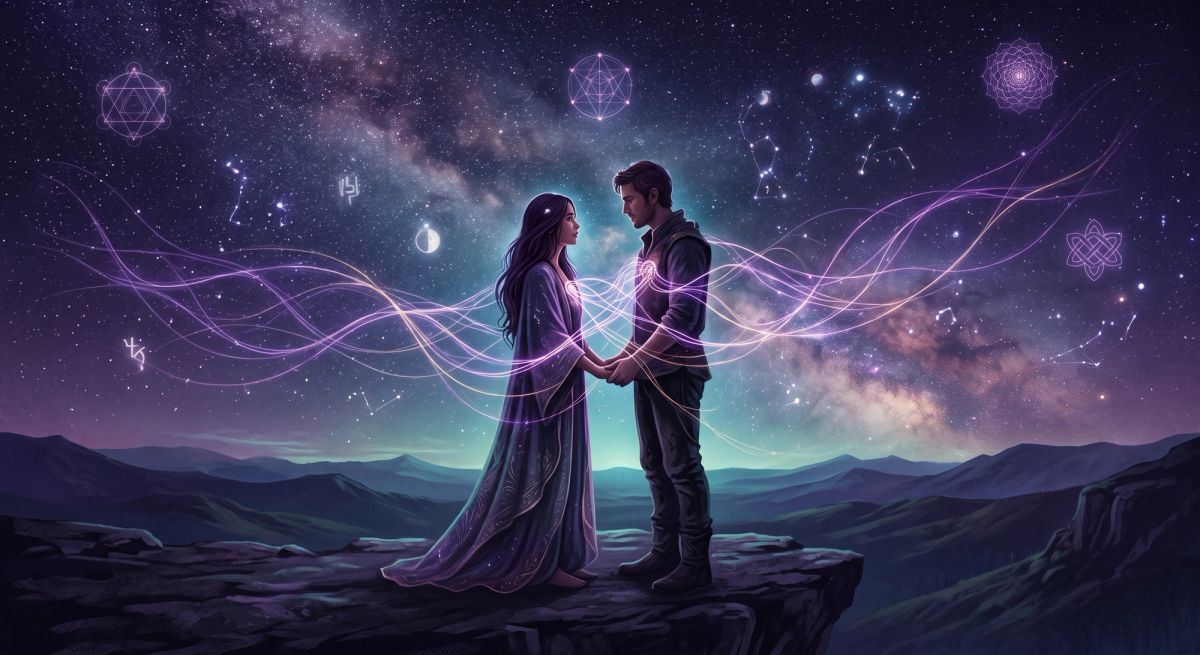
There are connections that feel strangely familiar from the very beginning.
You meet someone and something inside you shifts.
The attraction is immediate. The conversations feel deeper than they should. You find yourself thinking about them constantly. There is a sense that somehow, impossibly, you were meant to meet.
Sometimes that feeling is beautiful.
Sometimes it is an invitation to look deeper.
In relationship astrology, synastry can reveal why two people awaken such powerful feelings in one another. Certain planetary connections can create extraordinary chemistry, emotional intensity, fascination, or a feeling of spiritual recognition.
But intensity is not always the same thing as compatibility.
And a connection that feels karmic is not necessarily a connection that is meant to last forever.
This is where understanding synastry red flags can become a form of spiritual discernment.
Rather than asking, “Are we soulmates?”, a more meaningful question may be:
“What is this connection awakening within me?”
What Are Synastry Red Flags?
Synastry is the practice of comparing two birth charts to explore the energetic dynamics between two people.
Some connections feel peaceful and familiar. Others feel electric, challenging, mysterious, or almost impossible to resist.
A synastry red flag isn't necessarily an astrological sign that a relationship is doomed. Instead, it can point toward an area of the relationship where greater awareness may be needed.
Certain aspects involving Pluto, Neptune, Saturn, Mars, the Moon, Chiron, and the relationship houses can create particularly powerful experiences.
They may bring passion.
They may bring transformation.
They may bring healing.
And sometimes, they may reveal patterns that ask to be consciously understood rather than romantically idealized.
Astrology can describe the symbolism of a relationship. It cannot replace your lived experience of how someone treats you.
If a relationship consistently involves disrespect, manipulation, fear, coercion, or a violation of boundaries, those real-world experiences matter more than any synastry aspect.
When Intensity Feels Like Destiny
One of the most seductive ideas in spiritual relationship astrology is that overwhelming attraction must mean a person is your soulmate.
But not every powerful connection is necessarily meant to become a permanent partnership.
Some people enter our lives to awaken something.
Some challenge us to reclaim parts of ourselves we abandoned.
Some teach us about boundaries.
Some open our hearts.
And some simply show us what we are ready to see.
This doesn't make the connection meaningless.
It may make it more meaningful.
The spiritual question isn't always “Will this person stay?”
Sometimes it is:
“What is this relationship asking me to learn?”
5 Synastry Aspects That Can Feel Like Soulmate Connections
1. Venus Square Pluto: The Magnetic Pull
Few synastry aspects are discussed as often as Venus square Pluto.
Venus represents love, attraction, affection, beauty, and our relationship values. Pluto symbolizes depth, transformation, surrender, power, and the hidden parts of ourselves.
When these energies meet through a challenging aspect, attraction can feel incredibly powerful.
You may feel drawn toward someone before you even understand why.
The connection can feel consuming, transformative, or almost impossible to explain.
And that intensity can easily be interpreted as proof of a soulmate connection.
But Venus-Pluto energy asks a deeper question:
Can intensity exist without possession?
At its healthiest, this connection can encourage profound emotional honesty and transformation.
At its most difficult, it can awaken jealousy, fear of losing the other person, attachment, or attempts to control the relationship.
The spiritual lesson may not be “This person is the one.”
It may be:
“Can I experience deep love without losing myself?”
2. Moon Conjunct Chiron: When Someone Touches an Old Wound
The Moon represents our emotional world, instinctive reactions, comfort, and sense of belonging.
Chiron is often associated with the places where we carry vulnerability, and with the possibility of healing through awareness.
When one person's Moon connects closely with another person's Chiron, the relationship can feel remarkably familiar.
You may feel understood without having to explain everything.
You may sense the other person's vulnerability almost instinctively.
There can be a powerful feeling of “You see the part of me nobody else sees.”
That can be deeply healing.
But it can also become emotionally complicated.
A person may begin to feel responsible for healing their partner, or the relationship may repeatedly activate old emotional wounds.
The spiritual invitation is not necessarily to become one another's healer.
It may be to witness each other's vulnerability without taking responsibility for fixing it.
3. Mars Opposite Saturn: The Lesson of Patience and Freedom
Mars represents desire, action, passion, courage, and instinct.
Saturn represents boundaries, responsibility, patience, structure, and time.
When Mars and Saturn face one another through an opposition, the relationship can contain a fascinating mixture of attraction and resistance.
One person may feel inspired to move forward while the other instinctively slows things down.
One may crave spontaneity while the other needs security.
At times, this can create frustration.
But it can also teach something valuable.
Mars can teach Saturn to take risks.
Saturn can teach Mars patience.
The challenge comes when the lesson becomes a battle.
If one person constantly feels restricted and the other constantly feels pressured, resentment can gradually replace attraction.
The spiritual question becomes:
Can we honor each other's pace without trying to control it?
4. 8th House Synastry: The Connection That Goes Beneath the Surface
The 8th house is one of the most mysterious areas of relationship astrology.
It is associated with intimacy, vulnerability, shared energy, trust, transformation, surrender, and the parts of ourselves we don't reveal easily.
When someone's Sun, Moon, Venus, Mars, or other significant planet falls into another person's 8th house, the relationship can feel unusually deep.
There may be an immediate sense that something important is happening beneath the surface.
You may find yourself revealing things you normally keep private.
You may feel emotionally exposed.
You may experience a powerful fascination with the other person.
This is why 8th house synastry is sometimes associated with karmic or transformative relationships.
But depth requires trust.
Without honesty and healthy boundaries, intense intimacy can become fear, possessiveness, secrecy, or emotional confusion.
The spiritual lesson of 8th house connections may be about learning to share deeply without surrendering your personal power.
5. Neptune and the Descendant: When Love Becomes a Dream
Neptune is associated with dreams, intuition, spirituality, imagination, compassion, and mystery.
The Descendant represents the type of energy we encounter through close one-to-one relationships.
When Neptune strongly connects with the Descendant, someone can appear almost dreamlike.
You may feel as though you have finally met the person you imagined.
The relationship can carry an extraordinary sense of romance, spiritual connection, or emotional transcendence.
But Neptune also reminds us that love can sometimes become a projection.
We may fall in love with what someone represents rather than seeing who they actually are.
This doesn't mean the connection is false.
It means that clarity becomes part of the spiritual lesson.
Ask yourself:
- Do I know this person as they really are?
- Can I see both their strengths and imperfections?
- Am I responding to reality or potential?
- Are my boundaries still intact?
- Does the relationship feel peaceful when the fantasy fades?
Sometimes the deepest spiritual practice in love is simply seeing clearly.
Synastry Red Flags Don't Automatically Mean a Relationship Is Toxic
This distinction matters.
Astrology doesn't divide relationships into two simple categories: soulmate or toxic.
Real relationships are much more complicated.
A challenging synastry aspect can correspond with friction, but it can also represent growth, attraction, resilience, or transformation.
Likewise, harmonious synastry does not guarantee a healthy relationship.
Two people can have beautiful astrological compatibility and still struggle with communication, trust, timing, or personal choices.
Your birth chart describes symbolic patterns.
It does not remove free will.
What matters most is how those patterns are lived.
What Matters More Than a Single Synastry Aspect?
If you're exploring birth chart relationship compatibility, don't focus on one aspect in isolation.
Look at the entire energetic story.
The Moon: How You Feel Together
Moon connections can reveal emotional familiarity, comfort, sensitivity, and how two people respond to one another when life becomes difficult.
Ask:
Do I feel emotionally safe enough to be myself?
Mercury: How You Understand Each Other
Mercury speaks to communication, thought, listening, and the way two people exchange ideas.
Strong attraction can struggle when two people continually misunderstand each other.
Ask:
Can we actually hear one another?
Venus: How You Give and Receive Love
Venus reveals affection, attraction, values, pleasure, and relationship style.
Ask:
Do our ways of expressing love feel mutually nourishing?
Mars: How You Pursue and Desire
Mars can bring passion, chemistry, initiative, and sometimes conflict.
Ask:
Does our passion energize us or continually exhaust us?
Saturn: What Can Endure
Saturn is often associated with commitment, responsibility, patience, and the structures that allow relationships to survive changing seasons of life.
Ask:
Can we build something real together?
The Most Important Synastry Red Flag Isn't in the Chart
Sometimes we become so fascinated by astrology that we forget to look at the person standing in front of us.
No birth chart can excuse cruelty.
No soulmate theory should require you to tolerate disrespect.
No karmic explanation should convince you to ignore your own boundaries.
And no astrological aspect should make you believe that suffering is proof of love.
If someone repeatedly makes you feel small, unsafe, controlled, confused, or emotionally depleted, that experience deserves attention regardless of what the synastry chart says.
Spirituality should bring you closer to yourself, not further away from yourself.
Can a Relationship Survive Challenging Synastry Aspects?
Yes, challenging synastry does not automatically determine the outcome of a relationship.
In spiritual astrology, difficult aspects can sometimes become invitations to grow.
Venus-Pluto can invite deeper honesty around attachment and control.
Moon-Chiron can invite compassionate healing without codependency.
Mars-Saturn can teach patience and respect for different rhythms.
8th house connections can teach vulnerability without surrendering personal power.
Neptune connections can teach the difference between intuition and projection.
The question isn't whether the chart is perfectly harmonious.
The question is whether both people are willing to meet the relationship consciously.
Soulmate, Karmic Connection, or Life Lesson?
Sometimes we want astrology to give us a definitive answer.
Is this my person?
Are they my soulmate?
Are we twin flames?
Are we supposed to be together?
But relationships rarely reveal their meaning all at once.
A powerful connection can be meaningful without being permanent.
A difficult relationship can teach something without being meant to continue.
And a peaceful relationship can be deeply spiritual without feeling like a cosmic roller coaster.
Perhaps the most useful question isn't:
“Is this person destined for me?”
Perhaps it is:
“Who am I becoming through this connection?”
That question puts your spiritual journey back where it belongs - within you.
Explore Your Relationship Synastry
Your relationship cannot be understood through one planetary aspect alone.
Synastry is a conversation between two complete birth charts, revealing themes around attraction, emotional connection, communication, intimacy, growth, and commitment.
If you're curious about what your connection may be awakening, explore your full relationship compatibility rather than searching for a single “good” or “bad” aspect.
Explore your relationship compatibility with AstroGPT and discover the deeper themes, lessons, and energetic patterns within your connection.
Frequently Asked Questions About Synastry Red Flags
What are the biggest red flags in a synastry chart?
Synastry red flags can include intense patterns involving Pluto, Neptune, Saturn, Mars, Chiron, and the 8th house. However, no single aspect automatically means a relationship is unhealthy. The most important consideration is how the connection actually feels and behaves in real life.
Why does Venus square Pluto synastry feel like a soulmate connection?
Venus square Pluto can create powerful attraction, emotional intensity, fascination, and a feeling that the relationship is transformative. This can feel deeply meaningful, but intensity alone does not determine whether two people are compatible or meant to remain together.
What synastry aspects can indicate obsession?
Astrologers sometimes associate intense Pluto, Mars, Venus, Neptune, and 8th house connections with consuming attraction or fixation. These patterns are symbolic rather than guarantees of obsessive behavior. Real-world boundaries and behavior matter more than the chart.
Are 8th house synastry connections always difficult?
No. 8th house synastry can symbolize profound intimacy, vulnerability, trust, transformation, and emotional depth. It can feel intense because it touches private parts of the psyche, but intensity isn't inherently negative.
Can a relationship survive challenging synastry aspects?
Yes. Challenging aspects can describe areas requiring patience, communication, self-awareness, and growth. Relationship outcomes depend on many factors beyond astrology, including shared values, behavior, communication, boundaries, and mutual commitment.
How do you calculate relationship compatibility from birth charts?
Relationship compatibility in astrology is traditionally explored through synastry, which compares two people's birth charts. Exact birth dates, birth times, and birth locations can provide a more complete picture of planetary and house connections.
Is difficult synastry a sign of a karmic relationship?
Some astrologers interpret challenging or intense synastry as symbolic of karmic lessons or unfinished themes. This is a spiritual interpretation rather than something astrology can objectively prove. A meaningful relationship can be explored for its lessons without assuming that it is destined to last.
What is more important than a single synastry aspect?
The overall relationship pattern matters more than one aspect. Astrologers commonly consider the Moon for emotional connection, Mercury for communication, Venus and Mars for attraction, Saturn for commitment, and the broader interaction between both birth charts.
Curious what the sky says about you?
Get a reading built from your own birth chart, personal, specific, and always up to date.
Start for free