Tarot · 19 min read
Reversed Tarot Cards Meaning: Why Upside-Down Cards Aren't Bad Luck
Have you ever turned over a tarot card, noticed it was upside down, and felt a small wave of anxiety?
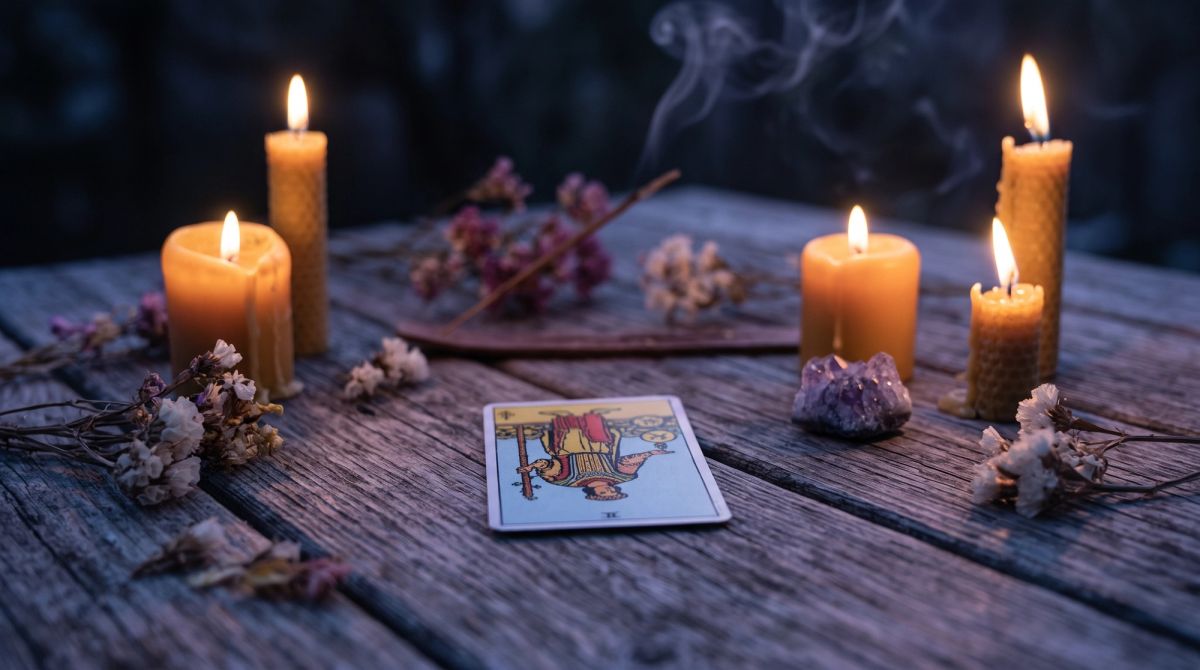
Perhaps you wondered whether something bad was coming. Maybe you worried that the card was warning you about heartbreak, loss, or a difficult change you couldn't prevent.
If you've ever felt this way, take a breath.
Reversed tarot cards are not automatically bad omens. In tarot, an upside-down card can represent an invitation to look within, a feeling that needs attention, a lesson that is still unfolding, or an area of life asking for greater balance.
Sometimes a reversed card speaks of resistance. Sometimes it reflects healing already taking place beneath the surface. And sometimes it simply asks you to pause before moving forward.
Tarot is a spiritual practice that can help you explore your feelings, recognize patterns, and listen more closely to your inner wisdom. It doesn't need to be approached with fear.
Instead of asking, "What terrible thing does this card predict?" try asking, "What is this card inviting me to understand?"
That small shift can transform the way you experience a tarot reading.
What Does a Reversed Tarot Card Mean?
A reversed tarot card is a card that appears upside down when drawn from a shuffled deck. Many tarot readers interpret reversals as a different expression of the card's traditional meaning rather than its complete opposite.
The spiritual meaning depends on the card, the question, the surrounding cards, and your own interpretation.
A reversal may symbolize:
- Inner reflection: An experience unfolding within you rather than in the outside world.
- Blocked energy: A feeling, desire, or lesson that you may be resisting.
- A period of healing: Emotional work that is happening quietly, even if you cannot see the results yet.
- An invitation to restore balance: An area of life that may need more care, attention, or healthier boundaries.
- A need for patience: Something that requires time, acceptance, or a different approach.
For example, the Sun reversed doesn't have to mean unhappiness. It might invite you to rediscover joy without needing approval from others.
The Chariot reversed might encourage you to reconsider your direction instead of pushing yourself harder.
And the Three of Swords reversed can offer a gentle reflection on healing after emotional pain.
There is no single interpretation that applies to every reading. The most helpful meaning is the one that resonates with the question while encouraging honest, compassionate reflection.
Are Reversed Tarot Cards Bad Luck?
No. Reversed tarot cards do not automatically mean bad luck, negative energy, or an approaching disaster.
An upside-down card is not a curse, and drawing one doesn't mean you've attracted something harmful into your life.
Tarot interpretations vary among traditions and individual readers. Some associate reversals with challenges or obstacles, while others see them as signs of spiritual growth, hidden strengths, or an opportunity to approach a situation differently.
Consider the Death card reversed. Rather than predicting literal death, it is commonly interpreted as a reflection on resistance to change, difficulty letting go, or the fear of beginning again.
The Devil reversed may represent the desire to break free from an unhealthy pattern.
The Tower reversed can invite you to explore an internal transformation or acknowledge a change you have been avoiding.
These interpretations are not guarantees about the future. They are symbolic ways to reflect on experiences that may be difficult to understand while you're living through them.
If a reversed card frightens you, remember that fear is not proof that the card carries a threatening message.
You are allowed to approach tarot with curiosity, discernment, and a sense of peace.
The Spiritual Meaning of Reversed Tarot Cards
Think of a reversed tarot card as a lantern turned toward a part of your inner world that you haven't fully explored.
Its message may not be about something going wrong. It may be about something asking to be understood.
Here are four gentle ways to explore the spiritual meaning of tarot reversals.
1. When the Energy Turns Inward
Some reversed cards invite you to bring your attention back to yourself.
You may be searching for happiness through achievement, recognition, or another person's approval when what you really need is to reconnect with your own sense of worth.
The Sun reversed is a beautiful example of this interpretation.
Upright, the Sun is associated with warmth, vitality, openness, and celebration. Reversed, it can encourage you to find your own light even when life feels less joyful than usual.
Perhaps you've been comparing yourself with others. Perhaps you've forgotten what makes you feel alive when nobody is watching.
The card becomes an invitation to rediscover the simple things that bring you peace.
Reflection: Where in my life am I waiting for someone else to give me permission to feel happy, confident, or worthy?
2. When Something Feels Blocked
Sometimes a reversed card reflects a part of your life where your intentions and actions are no longer moving together.
You may want change but fear the uncertainty that comes with it. You may long for connection while keeping your heart protected. You may feel ready to begin a new chapter but remain attached to the comfort of the familiar.
The Chariot reversed can symbolize this inner conflict.
Its message need not be that you've failed or lost control. It may be asking you to stop, examine your direction, and consider whether you are trying to move forward without first understanding what you truly want.
Not every obstacle requires more effort. Sometimes the wiser choice is to release pressure, clarify your intentions, and find a path that feels more aligned.
Reflection: Am I moving toward something I genuinely want, or am I simply afraid of standing still?
3. When Life Asks You to Be Patient
Some changes happen quietly.
A seed grows underground long before it reaches the sunlight. In much the same way, emotional healing, renewed confidence, and meaningful personal changes may begin long before their effects become visible.
The Eight of Wands reversed is often associated with delays, interrupted momentum, or communication that takes longer than expected.
Rather than treating the card as a prediction that something will go wrong, you might use it as an invitation to consider where patience could serve you.
Perhaps a conversation needs more time. Perhaps you need to gather information before making a decision. Or perhaps you are learning that not everything meaningful can be rushed.
Patience doesn't mean abandoning your intentions. It means allowing room for life to unfold while continuing to make thoughtful choices.
Reflection: What am I trying to force, and what might happen if I gave it a little more time?
4. When Your Shadow Asks to Be Heard
In spiritual practice, shadow work means exploring the feelings, fears, habits, and parts of yourself that you may prefer to hide or ignore.
These parts are not necessarily bad. They may have developed to protect you during difficult experiences, even if they no longer serve you in the same way.
A reversed tarot card can offer a symbolic starting point for this kind of reflection.
The Empress reversed, for example, may invite you to examine whether you give so much to other people that you neglect yourself.
You might recognize a pattern of overgiving, difficulty receiving help, or believing that your worth depends on how much you do for others.
The invitation is not to judge yourself. It is to understand the pattern with compassion.
You cannot always change what shaped you, but you can begin to choose how you respond today.
Reflection: What part of myself have I been pushing away that might need understanding rather than criticism?
The Meaning of Five Commonly Feared Reversed Tarot Cards
Some tarot cards have powerful imagery that can make their reversed appearance feel especially intense. Yet their meanings are often more nuanced than fear-based interpretations suggest.
The Tower Reversed: Transformation from Within
The Tower is associated with sudden revelations, disruption, and the collapse of structures that can no longer support us.
When reversed, it may symbolize resistance to change, a transformation unfolding internally, or the realization that something in your life needs to be rebuilt.
You might be questioning an old belief, recognizing that a relationship dynamic has become unhealthy, or admitting that a path you've followed for years no longer feels right.
The Tower reversed doesn't guarantee a crisis. Instead, it can invite you to examine what feels unstable and consider what you would like to build on a more honest foundation.
Spiritual message: You do not have to wait for life to force a change before listening to what your heart already knows.
Death Reversed: Learning to Release the Past
Despite its intimidating name, the Death card generally symbolizes endings, transitions, and the possibility of renewal in tarot.
Reversed, it is often associated with resistance to change or difficulty releasing something that has reached the end of its natural chapter.
This might be a relationship you keep revisiting, an identity you have outgrown, or a version of yourself you no longer need to protect.
Letting go doesn't mean that what came before was meaningless. It means allowing the past to have its place without requiring it to determine everything that comes next.
Spiritual message: You can honor what something meant to you without remaining where you no longer belong.
Three of Swords Reversed: Healing a Wounded Heart
The Three of Swords is commonly associated with heartbreak, grief, disappointment, and painful truths.
When reversed, it can symbolize the gradual process of healing, releasing emotional burdens, or finding a way to live with what has hurt you.
Healing is rarely a straight line. You may feel stronger one day and find old feelings returning the next. That doesn't mean you've lost your progress.
The card can remind you that healing doesn't require you to forget, excuse, or minimize what happened.
It asks you to consider whether you are ready to offer yourself the compassion you may have struggled to receive from others.
Spiritual message: Your pain is part of your story, but it does not have to define the rest of it.
The Devil Reversed: Reclaiming Your Freedom
The Devil card often represents attachment, temptation, unhealthy patterns, or the ways we can become trapped by fear and desire.
Reversed, it is frequently interpreted as a desire to break free from those patterns.
You might be recognizing a habit that no longer serves you, questioning a belief that limits your choices, or beginning to establish boundaries in a relationship.
Freedom doesn't always arrive as one dramatic moment. Sometimes it begins with a quiet realization that you have more choices than you once believed.
Spiritual message: Notice the patterns that hold you back, and remember that change can begin with one small, conscious choice.
The Lovers Reversed: Returning to Your Own Truth
The Lovers card is associated with love, connection, personal values, and meaningful choices.
Reversed, it can reflect misalignment, difficulty communicating, conflicting priorities, or a need to reconnect with your own values.
In a love reading, it does not automatically mean a breakup or infidelity. It may instead invite you to look honestly at how two people are relating to each other.
Are your needs being expressed? Are you making choices from love or fear? Are you sacrificing your own values to maintain harmony?
Sometimes the most loving step is an honest conversation. Sometimes it is a clearer boundary. Sometimes it is simply acknowledging what you truly feel.
Spiritual message: Lasting connection begins with honesty, with another person and with yourself.
How to Read Reversed Tarot Cards Without Fear
You don't need to memorize dozens of meanings to begin working with tarot reversals. A thoughtful question and a little patience can take you a long way.
Try this simple approach the next time you draw an upside-down card.
Step 1: Notice Your First Reaction
Before reaching for a guidebook, pause and look at the card.
What emotion does it bring up? Do you feel curious, uneasy, hopeful, or uncertain?
Your first reaction isn't necessarily the card's meaning, but it can help you identify what the reading brings to the surface.
If you feel afraid, ask whether the fear comes from the imagery itself or from something already happening in your life.
Step 2: Remember the Upright Meaning
Think about the central theme of the card.
Does it represent love, courage, change, intuition, stability, or new beginnings?
Understanding the upright meaning gives you a foundation for exploring its reversed expression.
For example, if the upright card represents confidence, the reversal might encourage you to explore self-doubt, private strength, or the difference between genuine confidence and the need for approval.
Step 3: Ask What Needs Attention
Instead of automatically assuming the opposite meaning, explore what might be happening beneath the surface.
Ask yourself:
- Is this energy being expressed too strongly or not strongly enough?
- Is there something I need to acknowledge or release?
- Am I resisting a change I know I need?
- Could this card represent healing that is still unfolding?
You don't need to find an answer to every question. Sometimes one honest insight is enough.
Step 4: Look at the Whole Reading
A single tarot card rarely tells the entire story.
Consider the question you asked, the position of the card in the spread, and the themes suggested by the other cards.
A reversed card in a position representing personal growth may carry a different emphasis from the same card in a position representing an external challenge.
Let the reading develop as a whole rather than allowing one upside-down card to dominate your interpretation.
Step 5: Choose a Grounded Next Step
The purpose of reflection is not to leave you feeling helpless. It is to help you understand your situation more clearly.
If the card raises questions about boundaries, consider one boundary you could communicate.
If it highlights impatience, identify what you can do while waiting.
If it brings up grief, allow yourself space to process your feelings.
You don't need to change your entire life because of a tarot reading. Let the cards inspire reflection, then make decisions using your own judgment and real-world circumstances.
Should You Read Tarot Cards Upright or Reversed?
There is no universal rule that says you must read reversed tarot cards.
Some readers interpret every card according to its upright meaning, using the question, the spread position, and the surrounding cards to explore challenges and hidden influences.
Others intentionally include reversals because they enjoy the additional symbolic depth.
Both approaches can be meaningful.
If you're a beginner, learning the upright meanings first can help you develop a strong relationship with your deck. Once those meanings feel familiar, you can begin experimenting with reversals if they appeal to you.
If upside-down cards create anxiety or make readings feel unnecessarily complicated, you can choose to turn them upright before interpreting the spread.
Tarot is a practice of reflection, not a test you have to pass.
The most important thing is to develop an approach that feels thoughtful, consistent, and supportive of your own spiritual journey.
A Simple Tarot Ritual for Understanding Reversed Cards
The next time a reversed card appears, create a quiet moment before deciding what it means.
You don't need elaborate tools or special knowledge. A few minutes of stillness can be enough.
1. Create a little space. Sit somewhere comfortable. If you like, light a candle or place a meaningful object beside you.
2. Take three slow breaths. Allow yourself to settle before interpreting the card. You don't have to force a particular feeling or state of mind.
3. Look at the card without judgment. Notice its colors, figures, symbols, and emotional atmosphere. Let yourself be curious rather than searching for a warning.
4. Ask one gentle question. Try, "What part of my life needs more understanding right now?" or "What am I ready to see differently?"
5. Write down what comes to mind. Record your thoughts without insisting that every impression is a spiritual message. You can revisit your notes later and see what remains meaningful.
6. Close with an intention. You might say, "I welcome clarity, meet myself with compassion, and give myself permission to choose my next step."
The ritual is not intended to control the future or remove negative energy. It is a way to slow down, listen inwardly, and approach uncertainty with greater care.
Explore Your Tarot Reading with AstroGPT
Sometimes a tarot card touches a feeling you haven't quite found the words for.
You might draw the Lovers reversed while questioning a relationship, the Tower reversed during a period of personal change, or the Hermit when you feel called to spend more time with yourself.
Understanding the traditional symbolism is a helpful beginning. Exploring how that symbolism connects with your own question can make the experience more personal.
With AstroGPT's tarot reading experience, you can explore card meanings, ask follow-up questions, and reflect on the themes that arise in your reading.
Rather than treating a reversed card as a fixed prediction, use the experience to consider different perspectives, uncover questions worth asking, and reconnect with your own intuition.
You don't need to approach tarot with fear or have every answer before you begin.
Explore your tarot reading on AstroGPT
Come with a question, an open mind, and a willingness to understand yourself a little more deeply.
Your reading doesn't have to tell you what will happen. It can help you reflect on where you are, what matters to you, and how you want to move forward.
Frequently Asked Questions About Reversed Tarot Cards
What does a reversed tarot card mean?
A reversed tarot card is one that appears upside down when drawn from a deck. It may symbolize blocked energy, inner reflection, a need for balance, emotional healing, resistance to change, or a different expression of the card's traditional meaning. The interpretation depends on the card, the question, and the overall reading.
Are reversed tarot cards bad luck?
No. Reversed tarot cards are not inherently unlucky and do not automatically predict negative events. Many reversals symbolize healing, liberation, renewed awareness, or the opportunity to change an unhelpful pattern. Tarot is best approached as a tool for reflection rather than a source of frightening or unavoidable predictions.
How do you read reversed tarot cards as a beginner?
Start by learning the upright meaning of the card. Then consider how its central theme might be turning inward, feeling blocked, needing balance, or unfolding more slowly. Look at the question you asked and the surrounding cards before settling on an interpretation. You don't need to memorize a separate meaning for every reversal.
Does a reversed tarot card mean the opposite of an upright card?
Not necessarily. Some readers interpret reversals as opposites, but others see them as internalized energy, excess, restriction, delayed development, or an invitation to reflect. For example, the Sun reversed might represent difficulty accessing joy or learning to cultivate happiness from within rather than a complete absence of happiness.
What does the Tower reversed mean spiritually?
The Tower reversed can symbolize resistance to change, internal transformation, or the realization that an old belief or structure no longer supports you. Its meaning is not necessarily a prediction of disaster. It may encourage you to examine what needs to change and consider how to approach that change consciously.
What does Death reversed mean in tarot?
Death reversed is commonly associated with resistance to endings, difficulty releasing the past, or hesitation about entering a new chapter. It does not generally indicate literal death. Spiritually, it can invite reflection on what you are holding on to and whether making peace with change could help you move forward.
What does the Devil reversed mean in a tarot reading?
The Devil reversed can represent recognizing unhealthy patterns, questioning limiting beliefs, establishing boundaries, or seeking greater personal freedom. It may encourage you to examine habits and attachments without judging yourself. Its interpretation depends on the question and the wider reading.
What does the Lovers reversed mean in a love reading?
The Lovers reversed may symbolize miscommunication, conflicting values, emotional distance, or a need to restore balance in a relationship. It does not automatically predict separation or betrayal. It can invite an honest look at whether your needs, choices, and relationship dynamics reflect what matters most to you.
Can reversed tarot cards indicate healing?
Yes. Some readers interpret reversals as signs of healing or a gradual release of emotional burdens. The Three of Swords reversed, for example, is often associated with recovering from heartbreak or beginning to process painful experiences. However, a card cannot confirm that healing is complete; your feelings and circumstances matter, too.
Is it okay to turn reversed tarot cards upright?
Absolutely. Reading reversals is optional. You can turn every card upright and explore its meaning through the question, spread position, intuition, and surrounding cards. Choose the method that helps you approach tarot with clarity and confidence rather than unnecessary fear.
Can tarot cards predict my future?
Tarot is used in different ways, including spiritual reflection, intuitive exploration, and divination. However, a reading cannot guarantee what will happen. You can use the symbolism to explore possibilities and clarify your feelings while remembering that your choices, circumstances, and other people's decisions also shape your life.
Where can I explore reversed tarot card meanings online?
AstroGPT offers a tarot reading experience where you can explore card symbolism and ask questions about the themes that appear in your reading. It can be a starting point for reflection on love, personal growth, life transitions, and the meaning you find in your cards.
Key Takeaways: Reversed Tarot Cards Meaning
- Reversed tarot cards are not automatically bad luck. An upside-down card is not a curse or a guarantee of negative events.
- Reversals have several possible meanings. They can represent inner reflection, resistance, imbalance, patience, healing, or an alternative expression of a card's central theme.
- Context matters. Interpret the card alongside your question, the spread position, and the other cards rather than relying on fear-based assumptions.
- Some reversed cards carry hopeful symbolism. The Devil reversed may suggest liberation, the Three of Swords reversed may reflect healing, and Death reversed may invite you to examine resistance to change.
- Reading reversals is optional. You can work with upright cards only if that approach feels more natural to you.
- Tarot should support personal agency. Use a reading to explore your feelings and choices, not as a substitute for your judgment or a fixed prediction of the future.
A Final Thought
The next time a tarot card appears upside down, you don't need to fear what it might be trying to tell you.
Pause. Breathe. Look again.
Perhaps the card is asking you to release an old belief, offer yourself more compassion, or give a new chapter the time it needs to unfold.
You don't have to interpret every symbol perfectly. You only have to remain willing to listen, reflect, and meet yourself honestly.
Sometimes the cards that first unsettle us become the ones that help us see ourselves with greater tenderness.
And that, too, can be a form of spiritual wisdom.
Curious what the sky says about you?
Get a reading built from your own birth chart, personal, specific, and always up to date.
Start for free