Astrology 101 · 24 min read
Aspect Patterns in Astrology: The Spiritual Meaning of Grand Trines, T-Squares, and Yods
Discover how Grand Trines, T-Squares, Yods, and other sacred patterns can illuminate your natural gifts, recurring challenges, and path toward greater self-understanding.
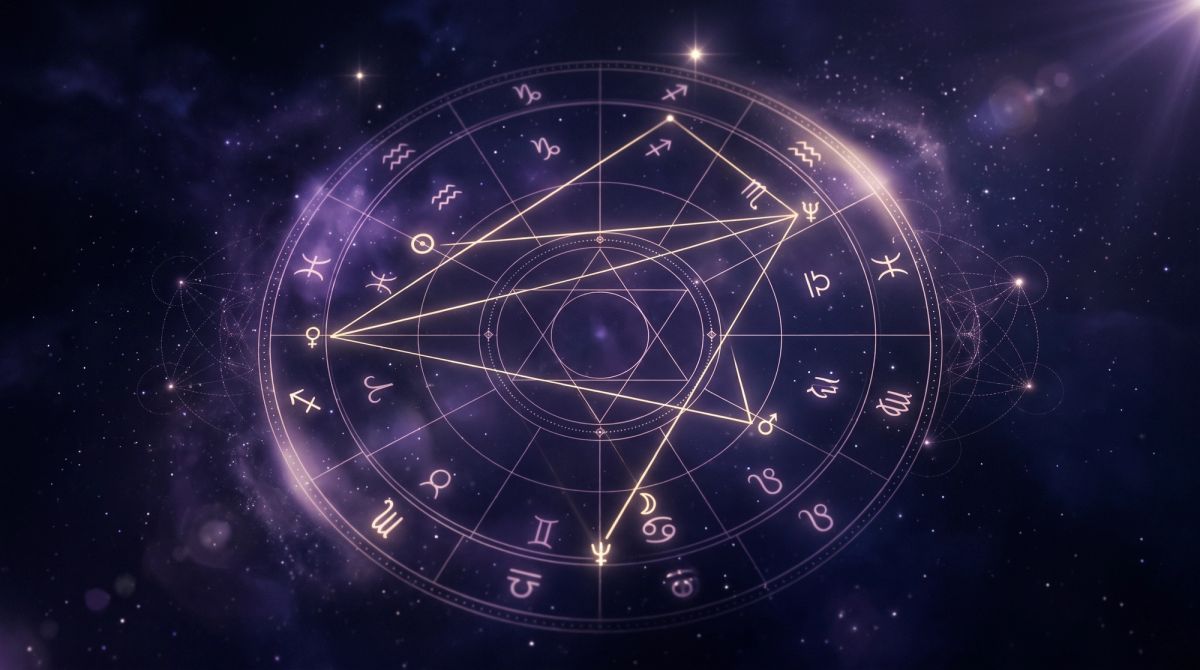
Your birth chart is more than a map of the planets at the moment you were born. In astrology, it can also be understood as a symbolic portrait of your inner world: your natural gifts, emotional patterns, desires, and the lessons you may return to throughout your life.
Look closely at a natal chart, and you may notice lines connecting different planets. Sometimes, these lines form recognizable shapes: a triangle, a cross, or an unusual pointed configuration. Astrologers call these shapes aspect patterns, and each has its own symbolic meaning.
A Grand Trine is associated with natural harmony and gifts that seem to come effortlessly. A T-Square represents tension that can inspire courage, growth, and meaningful change. A Yod, often called the Finger of God, is traditionally associated with adjustment, spiritual questioning, and periods when life seems to invite you in a new direction.
These patterns do not determine your fate. Instead, they offer a language for exploring your tendencies, understanding recurring experiences, and becoming more conscious of the choices available to you.
If your birth chart contains one of these configurations, consider it an invitation to look inward. Where does life feel naturally supportive? Where are you being asked to grow? And what part of yourself is waiting to be understood?
What Are Aspect Patterns in Astrology?
Aspect patterns in astrology are geometric configurations formed when three or more planets connect through specific angular relationships in a birth chart.
Each planet represents a different symbolic part of the human experience. The Sun is associated with identity and vitality, the Moon with emotional needs, Venus with love and values, and Mars with desire and action. The aspects between planets describe how these different parts of ourselves may work together or experience tension.
When several aspects connect to form a larger pattern, astrologers interpret the configuration as a theme that brings multiple areas of life into conversation.
Think of it as a melody rather than a collection of individual notes. Each planet contributes something distinct, but the relationship between them creates a larger story.
Some patterns symbolize ease, suggesting that certain talents or qualities may come naturally. Others symbolize friction, highlighting places where growth may require patience, courage, or a change in perspective.
Neither harmony nor tension is inherently better. Sometimes, what comes easily needs to be developed with intention. Sometimes, what challenges us becomes the doorway to our deepest wisdom.
Why Do Aspect Patterns Matter in a Birth Chart?
Aspect patterns can help you explore three important questions:
- What comes naturally to me? Some configurations are associated with intuitive abilities, creativity, emotional sensitivity, or practical strengths.
- Where do I experience recurring tension? Challenging patterns may symbolize competing desires, internal conflict, or lessons that call for greater awareness.
- How can I use these qualities consciously? Understanding a pattern may help you recognize familiar reactions and make choices that better reflect who you want to become.
Astrology offers symbolic interpretations rather than scientifically established predictions. Your experiences, relationships, environment, and decisions all shape how these themes unfold.
The Grand Trine: Natural Gifts, Inner Harmony, and the Wisdom of Movement
What Does a Grand Trine Mean in Astrology?
A Grand Trine is an aspect pattern in which three planets form a triangle, with each planet approximately 120 degrees from the other two. It is traditionally associated with harmony, ease, and a natural flow of energy.
Spiritually, a Grand Trine can symbolize an area of life where your gifts feel familiar, almost as though you have carried them with you for a long time.
You may understand people without needing many explanations. You may have an instinct for creating beauty, solving practical problems, communicating ideas, or finding meaning in emotional experiences.
Yet there is an important lesson hidden within this ease: a natural gift is an invitation, not a finished accomplishment.
When something comes effortlessly, it can be easy to overlook its value or assume it will always take care of itself. The deeper work of a Grand Trine is learning to honor your abilities by giving them direction, purpose, and expression.
The Four Elements and the Spiritual Meaning of a Grand Trine
The element associated with a Grand Trine offers another layer of interpretation.
Fire Grand Trine: Courage, Inspiration, and Creative Spirit
Fire is associated with passion, enthusiasm, confidence, and the desire to bring something new into the world.
A fire Grand Trine may symbolize a natural ability to inspire others, pursue a vision, or approach life with optimism. You may feel most alive when you are creating, leading, exploring, or following a meaningful calling.
Its spiritual invitation is to turn inspiration into sustained action. Enthusiasm becomes more powerful when it is supported by patience, humility, and commitment.
Reflection: What dream keeps returning to you, and what small step could bring it closer to reality?
Earth Grand Trine: Grounding, Stability, and Sacred Creation
Earth represents the physical world, practical wisdom, patience, and the ability to turn intentions into something tangible.
An earth Grand Trine may symbolize a gift for building, organizing, nurturing resources, or creating stability during uncertain times. You may feel most connected to yourself when your efforts produce something lasting.
Its spiritual invitation is to remain open to change. Security can be a beautiful foundation, but it does not have to become a reason to remain in situations that no longer support your growth.
Reflection: Where has the desire for stability helped you, and where might it be keeping you from a necessary new beginning?
Air Grand Trine: Insight, Communication, and the Power of Ideas
Air is associated with thought, curiosity, communication, and the exchange of perspectives.
An air Grand Trine may symbolize a natural gift for connecting ideas, understanding different viewpoints, or expressing complex thoughts in ways others can understand.
Its spiritual invitation is to bring the wisdom of the mind into relationship with the heart. Understanding something intellectually is not always the same as allowing it to change you.
Reflection: What truth do you understand in your mind but still need to live more fully?
Water Grand Trine: Intuition, Compassion, and Emotional Wisdom
Water represents feeling, imagination, sensitivity, and the hidden currents of the inner world.
A water Grand Trine may symbolize a strong imaginative life, emotional awareness, or an ability to respond compassionately to the experiences of others.
Its spiritual invitation is to honor sensitivity without becoming overwhelmed by it. Compassion does not require you to carry everyone's pain, and intuition can be balanced with reflection and clear boundaries.
Reflection: How can you remain open-hearted while also protecting your own emotional well-being?
Is a Grand Trine Always Lucky?
A Grand Trine is traditionally considered a harmonious configuration, but that does not mean a person with one will experience constant good fortune.
Its symbolism is more subtle. Natural strengths can make certain experiences easier, but they can also become so familiar that they go unnoticed.
A person may possess a wonderful creative gift without sharing their work, understand relationships without communicating their own needs, or have the ability to create stability while resisting necessary change.
The spiritual lesson of the Grand Trine is to recognize what flows naturally through you and decide how you want to use it.
Your gifts become meaningful not simply because you possess them, but because of what you choose to do with them.
The T-Square: Transforming Inner Conflict Into Growth
What Does a T-Square Mean in Astrology?
A T-Square is an aspect pattern in which two planets oppose one another while both form square aspects to a third planet, known as the apex.
In astrology, the opposition symbolizes two forces that may seem to pull in different directions. The squares introduce friction, creating a symbolic picture of competing needs, difficult choices, or areas where patience and awareness are required.
The apex planet represents a focal point for interpreting the tension.
Spiritually, a T-Square can be understood as an invitation to stop treating inner conflict as proof that something is wrong with you. Sometimes, opposing desires reveal that several important parts of your life need attention.
You may long for independence while also wanting security. You may crave closeness but fear losing yourself in a relationship. You may desire achievement while recognizing that your current pace leaves little room for rest.
The goal is not to eliminate every contradiction. It is to understand what each side is asking for and find a more conscious way forward.
Understanding the Apex Planet
The apex planet is often interpreted as a central area of focus within the T-Square.
Its sign, house, and planetary symbolism can offer clues about how the tension might be experienced and expressed.
For example, a T-Square involving Mars at the apex might invite reflection on anger, courage, assertiveness, or how you pursue your desires. If Venus occupies the apex, relationships, self-worth, harmony, and personal values may become important themes.
These interpretations depend on the entire chart, not just one configuration.
The spiritual practice is to notice your habitual response when pressure builds. Do you become controlling, withdraw, overwork, or seek approval? Awareness creates space between an old reaction and a new choice.
The Missing Leg: Finding Balance Beyond the T-Square
Astrologers sometimes look to the point opposite the apex, often called the missing leg of the T-Square, for an additional symbolic perspective.
This opposite point can suggest qualities that help bring balance to the configuration.
Rather than treating it as a secret solution, consider it a reminder that your familiar response may not be the only response available.
If you tend to act immediately, reflection may help. If you overthink every possibility, taking one grounded step may restore momentum. If you focus on keeping everyone happy, honest communication may help you reconnect with your own needs.
The aim is not to become a different person. It is to develop the qualities that allow different parts of your life to work together.
Cardinal, Fixed, and Mutable T-Squares
The modality of a T-Square adds another symbolic layer.
Cardinal T-Square: The Courage to Begin
Cardinal signs are associated with initiation and movement. This pattern may symbolize an urge to act, take responsibility, or create change when circumstances feel unsettled.
The lesson is to balance initiative with discernment. Not every difficulty needs an immediate solution.
Fixed T-Square: The Courage to Release
Fixed signs are associated with persistence, loyalty, and determination. This pattern may symbolize the strength to remain committed when life becomes difficult.
Its lesson is to recognize when perseverance is serving your growth and when it has become resistance to change.
Mutable T-Square: The Courage to Choose
Mutable signs are associated with flexibility, learning, and adaptation. This pattern may symbolize a mind that continually explores alternatives and searches for meaning.
Its lesson is to accept that uncertainty is sometimes unavoidable. You do not need to understand every possibility before taking a thoughtful step forward.
Is a T-Square a Sign of a Difficult Life?
No. A T-Square does not guarantee hardship, failure, or exceptional success.
In traditional astrological interpretation, it represents tension that may become a source of motivation, self-awareness, or perseverance. How that tension is experienced depends on many factors, including the wider chart and the person's circumstances.
You do not need to suffer to grow, and struggle is not proof that you are on the right path.
The deeper invitation of a T-Square is to approach conflict with curiosity. What needs are competing for your attention? What boundary needs to be established? What old response are you ready to reconsider?
Sometimes, the most meaningful change begins when you stop fighting yourself and start listening.
The Yod: The Finger of God and the Call to Realignment
What Is a Yod in Astrology?
A Yod is an aspect pattern formed when two planets are approximately 60 degrees apart, creating a sextile, and both form approximately 150-degree quincunx aspects to a third planet, known as the apex.
Its elongated triangular shape has earned it the traditional nickname the Finger of God.
Some astrologers interpret the Yod as a symbol of unusual life themes, persistent restlessness, or periods of adjustment that seem to redirect a person's attention toward something previously overlooked.
The name can sound dramatic, but a Yod does not prove that someone has been assigned a predetermined destiny or that a supernatural force controls their choices.
Its spiritual meaning is better approached as a question: What happens when the familiar parts of your life no longer fit together as comfortably as they once did?
A Yod can serve as a symbolic invitation to become more attentive to those moments.
The Spiritual Meaning of the Yod
Unlike configurations traditionally associated with harmony or direct tension, the Yod is often interpreted through the theme of adjustment.
Its two base planets may represent qualities that can work together relatively naturally. The apex planet introduces a different kind of need, one that may require patience, experimentation, and a willingness to see things differently.
You might recognize this theme when an established way of living no longer reflects your values, even though you cannot immediately identify what should replace it.
Perhaps you have achieved something you once wanted but now feel drawn toward a different purpose. Perhaps a relationship is asking you to communicate differently. Perhaps a long-standing ambition has begun to feel disconnected from the person you are becoming.
These experiences do not necessarily indicate a Yod or confirm a cosmic plan. They are simply examples of the kind of inner questioning that the configuration can symbolize.
The spiritual invitation is to treat uncertainty as an opportunity for reflection rather than a reason to fear the future.
Understanding the Apex Planet of a Yod
The apex planet is the focal point of a Yod and often receives particular attention in astrological interpretation.
Its symbolism can suggest the area in which adjustment, patience, or a new perspective may be especially important.
For example:
- Sun at the apex: Reflect on identity, purpose, recognition, and the difference between external expectations and authentic self-expression.
- Moon at the apex: Explore emotional needs, belonging, family patterns, and the importance of feeling safe enough to change.
- Venus at the apex: Consider love, values, self-worth, and the balance between connection and personal integrity.
- Mars at the apex: Reflect on courage, desire, anger, and how you direct your energy.
- Saturn at the apex: Explore responsibility, boundaries, patience, and the difference between meaningful commitment and unnecessary self-restriction.
These are broad symbolic possibilities, not fixed predictions. The planet's sign, house, other aspects, and the chart as a whole all matter.
Does a Yod Mean You Have a Special Destiny?
A Yod is sometimes described as a mark of a special mission or a life shaped by fated turning points. That language belongs to particular astrological traditions, not to an established method of predicting destiny.
You do not need a Yod to live a meaningful life, and having one does not mean that you must endure a particular struggle or fulfill a predetermined role.
A more grounded spiritual approach is to see the Yod as a symbol of the moments when growth asks you to become more conscious.
You may not be able to control every change that arrives, but you can reflect on what it reveals, seek support when needed, and decide how you want to respond.
Your purpose is not something you must prove through suffering. It can develop through the choices you make, the relationships you nurture, and the values you bring into everyday life.
Other Important Aspect Patterns in Astrology
Grand Trines, T-Squares, and Yods are not the only configurations astrologers interpret. Other patterns offer additional ways to reflect on the relationship between harmony, tension, and personal growth.
The Grand Cross: Finding Your Center Amid Competing Demands
A Grand Cross, also called a Grand Square, involves four planets connected through oppositions and squares, forming a cross-like configuration.
Symbolically, it can represent several competing priorities that seem equally important.
You may feel pulled between work and home, independence and commitment, personal ambition and emotional needs, or the desire to move forward and the need to remain grounded.
The spiritual lesson of the Grand Cross is not that life must be a constant struggle. It is to learn how to return to your center when different parts of your life demand attention.
Instead of trying to satisfy every competing need at once, begin by asking which values matter most, which commitments are realistic, and where a healthier boundary might help.
Inner stability does not require perfect circumstances. It can grow from the ability to make thoughtful choices within imperfect ones.
The Kite: Giving Your Gifts Direction
A Kite pattern combines a Grand Trine with an opposition involving one of its planets and a fourth planet.
The Grand Trine is traditionally associated with ease and natural ability, while the opposition introduces a contrasting force that can give the configuration a sense of direction.
Spiritually, the Kite can symbolize the movement from potential toward purposeful expression.
Perhaps you have a gift for teaching, creating, helping others, or understanding complex situations. The question becomes how to bring that gift into the world in a way that reflects your values.
The Kite invites you to give your talents a meaningful outlet. You do not need to wait until you feel completely ready before beginning to share what you have to offer.
The Mystic Rectangle: Bringing Opposites Into Harmony
The Mystic Rectangle consists of two oppositions connected by harmonious aspects, traditionally two trines and two sextiles.
It is often interpreted as a configuration that offers ways to work with contrasting perspectives.
Its spiritual symbolism centers on integration. You may discover that two apparently opposing needs can coexist when each is given appropriate attention.
Strength and gentleness, independence and intimacy, ambition and contentment are not always mutually exclusive. The challenge is to recognize when balance requires a thoughtful compromise rather than an all-or-nothing choice.
The Mystic Rectangle reminds us that wisdom often emerges when we stop insisting that one side of ourselves must defeat the other.
How to Find Aspect Patterns in Your Birth Chart
You do not need to be an experienced astrologer to begin exploring aspect patterns. A natal chart calculator can help you identify the configurations in your chart, while a little reflection can help you connect their symbolism to your lived experience.
Step 1: Generate Your Natal Chart
Use a birth chart calculator that allows you to enter your birth date, birth time, and birthplace.
An accurate birth time helps determine the Ascendant and house placements. If your birth time is unknown, some parts of the chart may be uncertain, particularly those that depend on the houses or the Moon's precise position.
Step 2: Look for the Main Geometric Shapes
Examine the aspect lines connecting the planets in your chart.
- A Grand Trine appears as a triangle formed by three planets.
- A T-Square involves two opposing planets that both square a third planet.
- A Yod appears as an elongated triangle with two quincunxes meeting at an apex.
- A Grand Cross involves four planets connected through oppositions and squares.
- A Kite combines a Grand Trine with an opposition involving a fourth planet.
- A Mystic Rectangle connects two oppositions through two trines and two sextiles.
Not every triangle or collection of lines represents a complete aspect pattern. The planetary angles must meet the requirements of the configuration.
Step 3: Check the Planetary Relationships
Astrologers use the term orb to describe the difference between an exact aspect and the actual angle between two planets.
Acceptable orbs vary according to the aspect, the planets involved, and the astrologer's preferred method. Some configurations, especially Yods, are commonly interpreted using relatively tight orbs.
If a chart calculator identifies a pattern, check which planets form it and whether the relevant aspects are sufficiently close. Do not assume that a visually similar shape automatically qualifies.
Step 4: Explore the Focal Planet
For a T-Square or Yod, begin with the apex planet. Consider its symbolic meaning, sign, and house placement.
Ask yourself:
- What part of my life does this planet symbolize?
- Where do I experience recurring questions or tension in this area?
- What response have I developed over time?
- What alternative response might help me grow?
If your chart contains a Grand Trine, consider where you may have natural strengths that deserve more attention or intentional practice.
If it contains a Grand Cross, reflect on which competing priorities need clearer boundaries or a more sustainable balance.
Step 5: Reflect Without Trying to Force a Meaning
Astrological symbols are most useful when they help you ask better questions, not when they become labels that limit your identity.
You may recognize a pattern strongly, relate to only part of its interpretation, or find that it does not describe your experience at all.
Allow your own experience to matter. A birth chart is a tool for reflection, not a verdict about who you are or what must happen next.
Working With Your Aspect Patterns as a Spiritual Practice
Once you have identified an aspect pattern, you can explore its meaning through a simple reflective practice.
You do not need special tools or an elaborate ritual. All you need is a quiet moment and a willingness to listen honestly to yourself.
For a Grand Trine: Honor the Gift
Write down three qualities that come naturally to you. They might include compassion, creativity, communication, persistence, or the ability to bring calm to difficult situations.
Choose one quality and ask how you could use it more intentionally this week.
For a T-Square: Listen to the Tension
Identify two needs that seem to conflict in your life. For example, you may want greater independence while also longing for security.
Instead of choosing one need and dismissing the other, ask what each is trying to protect or provide.
Then identify one small action that respects both as much as possible.
For a Yod: Make Space for Realignment
Think about an area of life that feels ready for change, even if you do not yet know what the change should look like.
Write down what no longer feels aligned with your values and what you would like to experience more of.
You do not have to make an immediate decision. Sometimes, the first step toward clarity is allowing yourself to acknowledge the question.
For a Grand Cross: Return to Your Center
List the responsibilities, relationships, and personal needs currently competing for your energy.
Which ones genuinely require your attention? Which expectations could be renegotiated? Where might a boundary help restore balance?
Choose one realistic adjustment rather than attempting to resolve everything at once.
For a Kite or Mystic Rectangle: Put Integration Into Practice
Reflect on two qualities that seem to pull in different directions. Consider how they might support each other instead of competing.
Then choose one practical way to express both in your daily life.
The purpose of these practices is not to make the planets work in your favor. It is to use astrological symbolism as a prompt for awareness, compassion, and more intentional choices.
What Your Birth Chart Can Teach You About Your Path
The deeper value of aspect patterns lies not in their shapes alone, but in the questions they inspire.
A Grand Trine invites you to recognize your gifts without taking them for granted. A T-Square invites you to meet tension with curiosity instead of self-judgment. A Yod invites you to reflect on the moments when adjustment opens the door to a new perspective.
A Grand Cross encourages you to find your center amid competing demands. A Kite asks how your gifts can become purposeful action. A Mystic Rectangle reminds you that opposing needs may be brought into a more thoughtful relationship.
None of these configurations guarantees success, hardship, spiritual awakening, or a particular destiny.
Your birth chart can offer a symbolic language for understanding yourself, but it does not replace your judgment or determine your future.
You are allowed to change. You are allowed to outgrow old patterns. You are allowed to discover that a strength you once relied on needs a different expression, or that a challenge you once feared has taught you something valuable.
The most meaningful reading is not the one that tells you who you must become. It is the one that helps you recognize who you are, what matters to you, and where you want to grow next.
Discover the Patterns in Your Birth Chart
Your birth chart may hold meaningful questions about your gifts, relationships, and personal growth. Exploring its aspect patterns can be a gentle starting point for understanding the themes that seem to repeat throughout your life.
Use the AstroGPT Birth Chart Calculator to explore your natal chart and discover the planetary relationships that shape its symbolic story.
As you explore, stay curious rather than searching for a fixed prediction. Let each pattern become an invitation to understand yourself with greater honesty, compassion, and care.
Start with your birth chart, and let self-discovery guide the way.
Frequently Asked Questions About Aspect Patterns in Astrology
What is an aspect pattern in astrology?
An aspect pattern in astrology is a geometric configuration formed when three or more planets connect through specific angular relationships in a birth chart. Examples include the Grand Trine, T-Square, Yod, Grand Cross, Kite, and Mystic Rectangle. Astrologers interpret these patterns as symbolic themes involving natural gifts, inner tension, relationships, and personal growth.
What is a Grand Trine in astrology?
A Grand Trine is a configuration in which three planets form a triangle through three trine aspects, each approximately 120 degrees apart. It is traditionally associated with harmony, natural abilities, and a relatively effortless flow of energy. Its spiritual meaning encourages people to recognize their gifts and use them consciously rather than taking them for granted.
Is a Grand Trine always lucky?
No. Although a Grand Trine is traditionally considered harmonious, it does not guarantee good fortune or a problem-free life. Astrologers often interpret it as an area of natural ability or ease. Its symbolic challenge is to develop those strengths intentionally and avoid overlooking opportunities simply because they come naturally.
What does a T-Square mean in a birth chart?
A T-Square forms when two planets oppose one another and both square a third planet, known as the apex. Astrologically, it symbolizes tension between competing needs or perspectives. Its spiritual interpretation focuses on self-awareness, resilience, and finding constructive ways to work with inner conflict.
What is the Yod or Finger of God in astrology?
A Yod is an aspect pattern in which two planets form a sextile of approximately 60 degrees, while both form quincunxes of approximately 150 degrees to a third planet. The third planet is the apex. Traditionally nicknamed the Finger of God, the Yod is associated with adjustment, restlessness, and the search for a more integrated direction in life.
Does a Yod mean you have a special destiny?
Not necessarily. Some astrological traditions associate a Yod with a distinctive life purpose or important turning points, but it cannot establish that a person has a predetermined destiny. A grounded interpretation treats the pattern as a prompt for reflection, helping you explore where greater flexibility, awareness, or a change in perspective may be useful.
What is the difference between a Grand Trine and a T-Square?
A Grand Trine consists of three trine aspects and is traditionally associated with harmony and natural strengths. A T-Square involves an opposition and two square aspects and is associated with tension and the need to reconcile competing forces. In spiritual interpretation, the Grand Trine asks how you can use your gifts, while the T-Square asks how you can grow through awareness and constructive change.
What is a Grand Cross in astrology?
A Grand Cross, also called a Grand Square, is a configuration involving four planets connected by four square aspects and two oppositions. It is traditionally interpreted as a symbol of competing demands, determination, and the challenge of finding balance across different areas of life.
What is the difference between a Yod and a Kite?
A Yod consists of two planets in a sextile, with both forming quincunxes to an apex planet. A Kite contains a Grand Trine and an opposition involving a fourth planet. Symbolically, a Yod emphasizes adjustment and realignment, while a Kite is often interpreted as natural gifts receiving direction through a contrasting influence.
How can I find aspect patterns in my birth chart?
Generate a natal chart using your birth date, time, and birthplace with an astrology calculator that identifies aspect patterns. Look for configurations such as triangles, T-shaped arrangements, and crosses, then verify that the planetary angles meet the relevant astrological criteria. Exact birth time is especially helpful for interpreting house placements and the Ascendant.
Can a birth chart have more than one aspect pattern?
Yes. A natal chart can contain several aspect patterns, and some planets may participate in more than one configuration. Astrologers interpret each pattern within the context of the whole chart rather than treating any single shape as a complete explanation of a person's character or life.
Are aspect patterns scientifically proven to predict personality or destiny?
No. Astrology has not been established as a scientifically reliable way to predict personality or future events. Many people nevertheless use birth charts as symbolic tools for reflection, meaning-making, and spiritual exploration. Aspect patterns are best approached as interpretive prompts rather than objective proof of a fixed life path.
Curious what the sky says about you?
Get a reading built from your own birth chart, personal, specific, and always up to date.
Start for free